
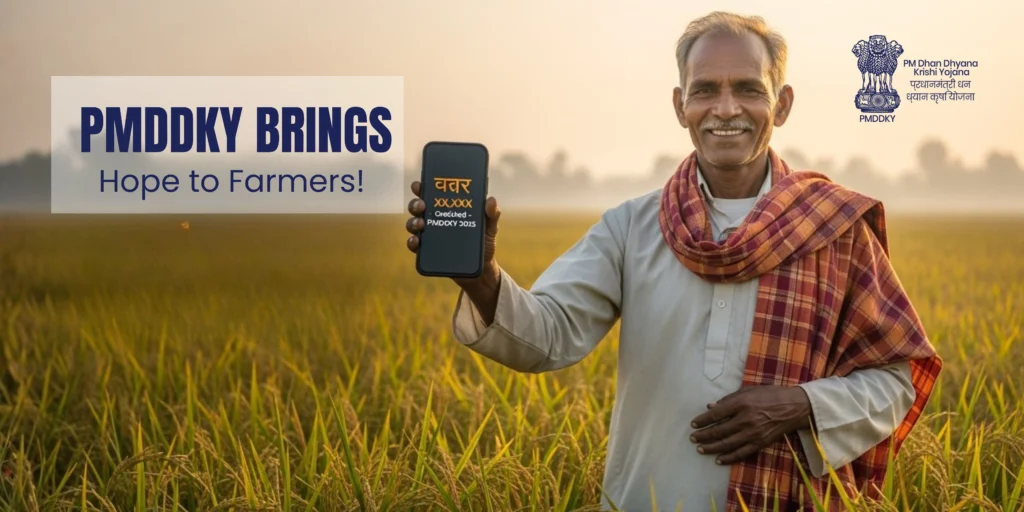
A young UPSC aspirant Gulshan preparing for the agriculture optional sits next to his grandfather in a remote village of Uttar Pradesh. As they drink tea, his grandfather says, “If this new scheme benefits us farmers, imagine the ripple effect on our income and India’s food security.” This simple conversation underlines why the Pradhan Mantri DhanDhaanya Krishi Yojana (PMDDKY) matters, both for the farmer and for aspirants studying for the Union Public Service Commission (UPSC). In this article, we will explore what PMDDKY is, its context, how it works, why it matters for UPSC, and how it links with other schemes like PM Dhan Dhanya Krishi Yojana (another naming variant) and Pradhan Mantri Kisan Samman Nidhi Yojana (PM-KISAN).
Why this PMDDKY UPSC scheme deserves attention
For UPSC aspirants, every year there are major agricultural reforms and flagship schemes announced by the government that become part of current affairs, general studies, agriculture optional and ethics papers. “PMDDKY UPSC” therefore is highly relevant. The scheme is significant because:
- It targets 100 under-performing agricultural districts in India, indicating the government’s focus on lag-gard regions.
- It is a convergence of 36 existing agricultural schemes from 11 ministries, which means it reflects administrative coordination and scheme rationalization, a recurring theme for UPSC.
- It aims at boosting productivity, cropping intensity, allied sectors, storage infrastructure and credit access, all important for agriculture, rural development, governance and economy sections of the syllabus.
- It has implications for small and marginal farmers, women farmers and allied sectors like dairy/fisheries/animal husbandry, hence linking to social justice, gender, and inclusive development issues.
- What is the scheme?
- The Pradhan Mantri Dhan-Dhaanya Krishi Yojana (PMDDKY) is a new agriculture initiative launched by the Government of India. Key details:
- It was announced in the Union Budget 2025-26
- The scheme is to be implemented over six years (2025-26 to 2030-31) in 100 selected districts across India.
- It will be implemented through convergence of 36 existing agriculture-architecture schemes from 11 departments, and state/local partnerships.
- Selection of districts is based on three criteria: low productivity, moderate/low cropping intensity, and less credit disbursement.
- A District Dhan Dhaanya Samiti will be set up in each selected district, which will prepare a District Agriculture and Allied Activities Plan (DAAAP) aligning with national goals of crop diversification, soil & water health, organic farming, allied sectors etc.
Objectives of the scheme
Some of the main objectives of PMDDKY (and its variant naming “pm dhan dhanya krishi yojana”) are:
- Enhancing agricultural productivity in the selected districts, raising yield levels.
- Improving cropping intensity, enabling more than one cropping cycle, inter-cropping, diversification into allied sectors.
- Ensuring access to credit and irrigation, allied activities (dairy, fisheries, poultry), post-harvest infrastructure such as storage, warehouses, cold chains at block/panchayat level.
- Promoting sustainable/organic farming, water conservation, soil health, climate-smart practices.
- Enhancing farmer incomes and agrarian livelihood in the lagging districts. For aspirants, this links to the national goal of doubling farmer income and rural upliftment.
- Ensuring equitable regional development by choosing at least one district per state/UT.
- These objectives make it a flagship scheme in the context of rural/agricultural transformation, and thus relevant for PMDDKY UPSC.
- Scope, target and budget
- The scheme covers 100 districts across India, chosen based on the criteria mentioned.
- The timeline is six years (2025-26 to 2030-31).
- While exact district lists are not always final, the process has started, and states are preparing proposals. For example, Uttar Pradesh is preparing a plan under this scheme.
- The budget allocation is around ₹24,000 crore annually (in some reports) for the six-year period, though some other news mentions higher aggregated numbers.
- The scheme is expected to benefit around 1.7 crore farmers (as per some sources) over its duration.
- For UPSC, it’s good to note the period, budget, target numbers and scope of coverage.
- Convergence and linkages with other schemes
- One of the notable features is convergence: The scheme brings together 36 existing schemes from 11 ministries. Some of the linked schemes include:
- Pradhan Mantri Kisan Samman Nidhi Yojana (PM-KISAN) — direct income support to farmers
- Pradhan Mantri Fasal Bima Yojana (PMFBY) crop insurance scheme
- Pradhan Mantri Krishi Sinchayee Yojana (PMKSY) — irrigation coverage
- Rashtriya Krishi Vikas Yojana (RKVY) agricultural development scheme
By convergence, the scheme aims to reduce overlaps, optimize resources and improve outcomes. For UPSC analysis this shows a shift from standalone silos to integrated mission-mode programs — a key theme in governance and public policy.
Why is it significant for PMDDKY UPSC aspirants?
Eligibility, application process and key features
Eligibility & coverage
- Small and marginal farmers, women farmers, young farmers engaged in allied sectors (dairy, fisheries, poultry, apiculture) in the selected 100 districts are priority.
- Farmer Producer Organizations (FPOs) and cooperatives may also be involved.
- The farmer must belong to a selected district (yet to be formally announced). Geographical eligibility is important.
Application process
- Since the PMDDKY UPSC scheme is still in its rollout phase, application forms, digital portals, and offline centers will soon be made available for registrations.
- Each district will have a District Dhan Dhaanya Samiti, which will handle local implementation, including registrations, verification of beneficiaries, and execution of the district agriculture plan.
- The committees will also verify eligibility, monitor key performance indicators (KPIs), and ensure timely delivery of benefits to farmers under the pmddky upsc framework.
Key features / benefits
- Support for irrigation (micro-irrigation, drip/sprinkler) to improve water use efficiency.
- Post-harvest infrastructure at village/block level: warehouses, cold storage, processing units.
- Credit facility: short-term and long-term loans for equipment, allied activities.
- Technology adoption: Soil health, organic farming, allied sectors diversification.
- Market linkages: FPOs, digital platforms, value-addition for farmers.
- All of these features help improve cropping intensity, productivity and incomes.
Implementation Mechanism & Monitoring under PMDDKY UPSC
The Pradhan Mantri Dhan-Dhaanya Krishi Yojana (PMDDKY), popularly known in exam circles as pmddky upsc, is designed with a robust institutional and digital governance framework to ensure effective execution and transparency. The implementation mechanism focuses on a multi-tiered monitoring structure involving the central, state, and district levels.
Implementation Structure
- At the national level, a National Steering Committee will oversee the overall execution of the PMDDKY UPSC scheme, ensuring alignment with government priorities and timely fund utilization.
- State nodal departments will coordinate the rollout, supervise implementation, and integrate state-level schemes with PMDDKY’s objectives.
- At the district level, a District Dhan Dhaanya Samiti, chaired by the District Collector, will prepare and implement the District Agriculture and Allied Activities Plan (DAAAP). This localized approach ensures that the unique needs of each district are addressed effectively under the pmddky upsc initiative.
Monitoring & Evaluation
- A digital dashboard tracking 117 Key Performance Indicators (KPIs) will be established for real-time monitoring of the scheme’s progress across the 100 selected districts. This dashboard will help track outcomes such as productivity, cropping intensity, irrigation coverage, and farmer income growth.
- Monthly monitoring will be conducted at district, state, and national levels, ensuring transparency and accountability — a critical aspect of the governance model under pmddky upsc.
Convergence Mechanism
- One of the most significant features of the PMDDKY UPSC framework is convergence. The scheme integrates 36 existing agriculture and allied sector schemes from 11 different ministries, reducing duplication of efforts, optimizing resource utilization, and improving accountability.
- This convergence ensures that funds, manpower, and technical support from various departments work synergistically toward common agricultural development goals.
Funding Model
- The funding will be drawn through a convergence-based approach, combining resources from existing scheme budgets.
- State governments may contribute through matching shares, ensuring collaborative implementation.
- The emphasis on resource efficiency and multi-source funding makes pmddky upsc a sustainable and scalable agricultural transformation mission.
Where does “PM Dhan Dhanya Krishi Yojana” and “PMDDKY” fit in?
You may have seen alternate names: “pm dhan dhanya krishi yojana”, “pmddky”, “PM-Dhan-Dhaanya Krishi Yojana”. These are essentially the same scheme, and as a UPSC candidate you must recognise synonyms.
- The full name: Pradhan Mantri Dhan-Dhaanya Krishi Yojana (PMDDKY)
- The alternate phrase “PM Dhan Dhanya Krishi Yojana” appears in media.
- Abbreviation “PMDDKY” is used widely.
- So, when you see a question or content referencing any of these, they refer to this flagship 2025 agriculture scheme.
- For optimum keyword usage in this article: we’ve treated “pmddky upsc” as the main keyword (targeted for exam-readers), and “pm dhan dhanya krishi yojana” and “pmddy” as supporting keywords.
Benefits and expected impact
For farmers, districts and the nation, the scheme promises multiple benefits (PMDDKY UPSC):
- Increased productivity: By providing better irrigation, quality inputs, allied sector diversification and storage infrastructure, yields are expected to rise in lagging districts.
- Higher cropping intensity: More than one crop per year, inter-cropping and allied ventures reduce idle land and boost income per hectare.
- Reduced post-harvest losses: Infrastructure will help farmers store produce and avoid distress sale, leading to better value realization.
- Diversified income: Allied sectors like dairy, fisheries, poultry, apiculture give additional income opportunities beyond traditional cropping.
- Women & youth participation: With dedicated focus on women farmer producer groups and youth agripreneurs, inclusive growth is promoted.
- Regional development: By targeting backward districts, the scheme seeks to reduce regional imbalances in agriculture.
- Link to self-reliant India (Atmanirbhar Bharat): By boosting domestic production, reducing imports, and strengthening value chains.
For UPSC writing, you can mention case studies, e.g., districts like Bilaspur (Himachal Pradesh) being selected under the scheme.
Challenges and concerns (for critical analysis)
No scheme is without challenges. As an aspirant, you should be able to critically analyze schemes and mention possible bottlenecks and suggestions (PMDDKY UPSC):
- Coordination complexity: Converging 36 schemes across 11 ministries and multiple state departments is administratively difficult. Risk of duplication, overlap or gaps.
- Implementation disparity: Selected districts vary widely in infrastructure, capacity, literacy and terrain. Implementation may lag in remote areas.
- Awareness & reach: Small and marginal farmers may not be aware of the scheme or may lack access to application portals or offline support.
- Monitoring & evaluation: Though 117 KPIs are proposed, their meaningful measurement, data collection reliability, and transparency will be key.
- Resource allocation: Even though budget numbers are given, fiscal pressures, state share commitments or competing demands may delay rollout.
- Sustainability: Interventions such as storage and irrigation demand maintenance; allied activities require linkages to market and support.
- Behavioural change: Farmers may be resistant to shifting from traditional cropping to diversification or organic methods.
- Credit risk: Loans have to be repaid; if crop failure or market volatility hits, credit defaults may increase.
For UPSC, you could suggest ways forward: strengthening extension services, mobile and digital agriculture apps, capacity building of FPOs, public-private partnerships, farmer clubs, climate-smart agriculture, linking to minimum support price (MSP) and procurement frameworks, gender mainstreaming, etc
How should UPSC aspirants study this scheme (PMDDKY UPSC)?
Here are tips:
- Memorize the full name: Pradhan Mantri Dhan-Dhaanya Krishi Yojana (PMDDKY). Also know the alternate name variant “PM Dhan Dhanya Krishi Yojana”.
- Note the key features: six-year mission, 100 districts, convergence of 36 schemes, focus on low-productivity districts.
- Understand objectives: productivity, cropping intensity, allied sectors, storage, credit, inclusion.
- Institutional mechanism: National, State, District level committees; District Dhan Dhaanya Samiti; dashboard with 117 KPIs.
- Benefits: irrigation, storage, credit, allied sectors, women, youth, income enhancement.
- Implementation status: approved by Cabinet July 2025, rollout begins October 2025 (as per announcements) for Rabi season.
- Inter-linkages: Know linked schemes (PM-KISAN, PMFBY etc), and how this scheme uses convergence.
- Critical analysis: Be ready with challenges and suggestions.
- Use case-studies or district examples (e.g., Bilaspur, UP districts) to illustrate.
- Link it to bigger picture: doubling farmer income, food security, Atmanirbhar Bharat, rural employment, and sustainable agriculture.
Frequently Asked Questions (FAQs)
In a dusty field of a backward district, a farmer sighs, “If someone helps me irrigate one more crop, I can finally think of sending my daughter to college.” And that hope lies at the heart of the PMDDKY scheme, for the farmer to dream, and for aspirants like you to document how policy can shape lives. The pmddky upsc angle is not just about memorizing details but understanding a broader governance shift: from fragmented schemes to integrated strategic push. As you prepare for your exam and seek to teach yourself or others about “pm dhan dhanya krishi yojana” or “pmddy”, remember it is more than a scheme, it is about turning the soil of neglected districts into seeds of growth, inclusion and resilience.
For official government services, please visit: www.pib.gov.in
Click here to learn more about: www.pmddky.org